
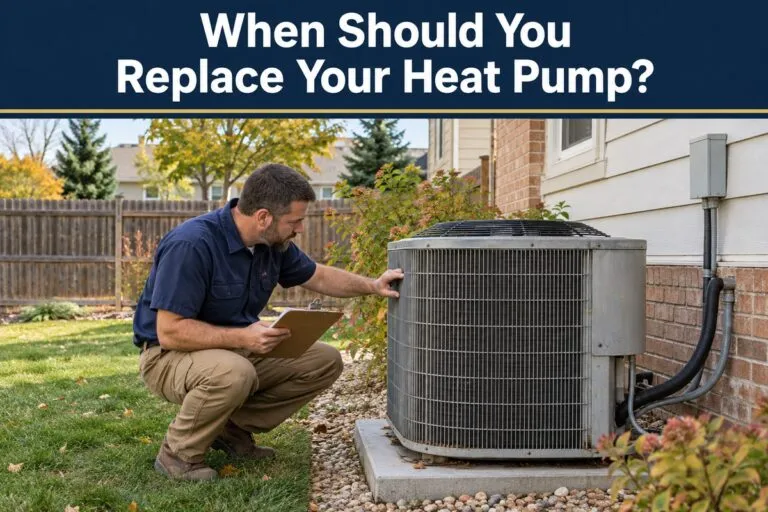
Knowing when you should replace your heat pump comes down to its age, repair history, operating costs, and ability to keep your home comfortable. Replacement deserves serious consideration when an older system needs an expensive repair, breaks down repeatedly, or struggles to maintain your thermostat setting after underlying problems have been addressed.
For homeowners in Englewood, CO, and the Denver Metro area, reliable heating and cooling are essential through changing seasons. Recognizing replacement warning signs early gives you time to compare options and make a decision before an unexpected breakdown.
How Long Does a Heat Pump Last?
According to Carrier’s heat pump lifespan guidance, a typical air-source heat pump lasts approximately 10 to 15 years. Actual service life varies with maintenance, installation quality, climate, and how heavily the equipment is used. Some systems continue operating beyond that range.
Age is a planning tool, not an automatic replacement deadline. A well-maintained unit that keeps your home comfortable may still be worth repairing, while a younger system with serious recurring problems needs a closer evaluation.
Start Evaluating Replacement After 10 Years
ENERGY STAR recommends considering replacement when a heat pump is more than 10 years old, particularly when repairs become frequent or energy bills increase. That recommendation is a reason to assess the equipment, not proof that every system over 10 years old has failed.
If your system is approaching this age, gather its installation date, maintenance records, warranty information, and recent repair invoices. These details help an HVAC technician give you a more useful repair-versus-replacement recommendation.
Warning Signs Your Heat Pump May Need Replacement
A single problem does not always justify new equipment. Several problems occurring together, especially on an aging system, make replacement more compelling.
Repairs Are Becoming Frequent or Expensive
An occasional repair can be a reasonable cost of ownership. Repeated service calls deserve a broader discussion about the condition of the entire system.
Before authorizing another major repair, ask:
- What caused the failure?
- Does the repair address the underlying problem?
- Are other major components showing signs of deterioration?
- Are replacement parts available?
- What parts and labor are covered by warranty?
- What would a complete replacement cost?
A compressor failure on an older heat pump warrants a different decision than a minor electrical repair on otherwise dependable equipment. Request written estimates for both options when the proposed repair is substantial.
Heating and Cooling Performance Keeps Declining
If your home no longer reaches its thermostat setting, schedule a diagnostic visit before assuming the heat pump needs replacement.
ENERGY STAR notes that uncomfortable rooms can result from equipment problems, duct issues, or inadequate insulation. Replacing the heat pump alone may leave those problems unresolved.
Describe when the discomfort occurs and whether it affects the entire house or particular rooms. A system that struggles only during the coldest weather needs a different assessment from one that cannot maintain comfort during mild conditions.
Ice Remains on the Outdoor Unit
Some frost during heating operation is normal, and the heat pump’s defrost cycle is designed to clear it. Ice that persists or heavily coats the outdoor unit calls for professional service.
According to Trane’s heat pump troubleshooting guidance, persistent freezing can involve low refrigerant, malfunctioning defrost controls, or a faulty sensor. These symptoms require diagnosis rather than an automatic replacement recommendation.
If the same icing problem returns after repairs, ask whether the original cause was fully corrected and whether additional repairs are practical given the system’s age.
Rising Energy Bills: When Efficiency Becomes a Replacement Issue
Higher utility bills can raise concerns about an aging heat pump, but the dollar amount alone does not tell the whole story.
Compare electricity consumption in kilowatt-hours, along with rates, outdoor temperatures, and thermostat settings. A colder month or an increase in electricity prices can raise your bill without indicating equipment failure.
Bring several months of bills to your service appointment. Ask the technician to evaluate whether the change reflects a repairable problem, increased backup heating, or declining equipment performance.
Frequent Auxiliary Heat Needs Investigation
Auxiliary heat can operate normally during cold weather or a defrost cycle. Electric resistance backup heat uses more energy than heat pump operation, so excessive reliance on it can increase heating costs. Trane’s auxiliary heat guidance explains these normal operating conditions.
If auxiliary heat appears more frequently than it used to under similar conditions, have the system checked. Do not assume the thermostat’s AUX indicator means replacement is necessary.
For an Englewood home, the assessment should consider whether the existing equipment has enough heating capacity for the home and whether its backup heat controls are configured appropriately.
Should You Repair or Replace Your Heat Pump?
The best decision considers what you will spend, what the repair accomplishes, and how much confidence you have in the remaining equipment.
When Repair May Be the Better Choice
Repair deserves consideration when:
- The problem is isolated and clearly diagnosed.
- The system has otherwise been reliable.
- Warranty coverage substantially reduces the expense.
- Heating and cooling performance remains satisfactory.
- The technician finds no other significant deterioration.
Avoid replacing dependable equipment solely because it reaches a particular birthday. A documented assessment is more useful than an age-based sales recommendation.
When Replacement Becomes More Reasonable
Replacement deserves stronger consideration when an older heat pump needs a major repair, has multiple deteriorating components, or has become unreliable despite appropriate service.
Carrier suggests considering replacement when a repair reaches approximately 50% of the cost of a new system. Treat this as a comparison guideline rather than a universal rule. Warranty coverage and overall equipment condition still matter. Carrier Residential
For example, if a hypothetical repair costs $4,000 and a comparable installed replacement costs $8,000, the repair equals half the replacement price. These figures illustrate the calculation; they are not Denver-area price estimates.
Money already spent on past repairs cannot be recovered. Use that history to judge reliability, then compare the costs and benefits of your options from this point forward.
What Should a Heat Pump Replacement Estimate Include?
A replacement quote should explain the complete installation, not just the price of the outdoor unit.
Ask for a written scope covering:
- Exact equipment model numbers.
- Compatible indoor equipment and controls.
- Required electrical or duct modifications.
- Removal and disposal of existing equipment.
- Applicable permits and inspections.
- Startup testing and system setup.
- Equipment and labor warranty terms.
Ask the contractor to identify which existing components can remain and why they are compatible. This makes it easier to compare estimates that initially appear very different in price.
Confirm Proper Sizing Before Ordering Equipment
Do not assume the replacement should have the same capacity as your current system. Changes to insulation, windows, finished space, or the original installation can affect what your home needs.
The U.S. Department of Energy identifies oversizing, improper refrigerant charging, and leaky ducts as causes of efficiency losses, discomfort, and shortened equipment life. Ask for a heating and cooling load calculation and an assessment of the existing ductwork.
Choosing a Replacement Heat Pump for Englewood and Denver
When replacement is justified, evaluate heating performance alongside cooling efficiency. An attractive efficiency rating alone does not tell you whether a particular model will meet your home’s winter heating needs.
Compare Efficiency Ratings and Cold-Weather Capacity
Two ratings help you compare equipment:
- SEER2: A measure of seasonal cooling efficiency.
- HSPF2: A measure of seasonal heating efficiency.
Higher values indicate greater efficiency under the applicable test conditions. These ratings do not guarantee a particular monthly bill. ENERGY STAR explains both measures in its heat pump criteria.
For Denver Metro heat pump replacement, also ask about the equipment’s heating output at low outdoor temperatures. ENERGY STAR identifies cold-climate heat pumps as equipment designed to provide improved heating performance in low-temperature conditions.
Have your contractor explain how the selected equipment’s capacity compares with your home’s calculated heating demand and when backup heating would be expected to operate.
When Is the Best Time to Replace Your Heat Pump?
If the system remains operational, begin planning before an urgent replacement becomes necessary. This gives you time to review estimates, resolve installation questions, and arrange the work around your schedule.
Spring and fall are useful times to evaluate aging equipment ahead of heavier seasonal use. ENERGY STAR recommends preseason heating and cooling checkups and notes that contractors become busier during summer and winter.
Do not delay an assessment simply to reach a preferred season if the system repeatedly loses heating or cooling. Schedule service, establish the cause, and decide whether another repair provides reasonable value.
Knowing when to replace your heat pump starts with a clear picture of its condition. Age, repair costs, comfort, and operating performance should all support the decision. If your equipment is becoming unreliable, contact David’s HVAC to discuss your heating and cooling needs in Englewood, CO, or the Denver Metro area and take the next step toward dependable home comfort.
Content reviewed and published according to the David's HVAC Editorial Team.