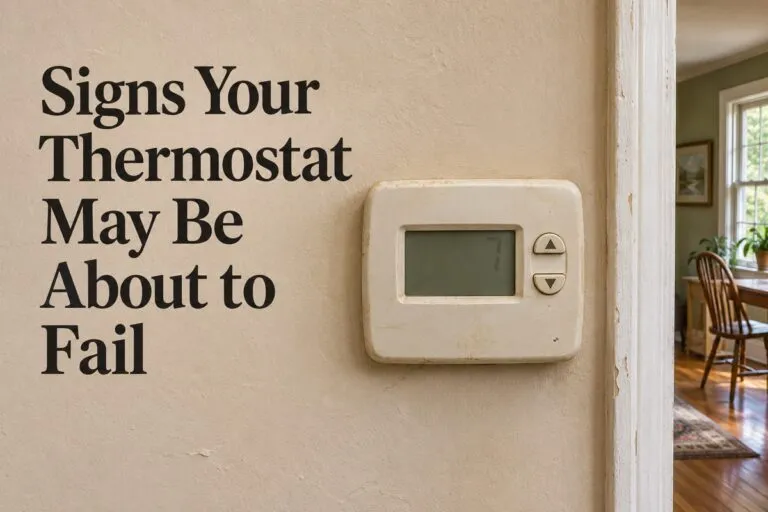
Knowing the signs your thermostat may be about to fail can save you from a hot house in summer or a cold one in winter. A thermostat is small, but it tells your whole HVAC system what to do. When it starts to act up, your comfort and your energy bills can suffer.
The good news is that a failing thermostat usually gives warnings first. Spot them early, and you can fix the problem before it turns into an emergency. Here are the signs to watch for.
Common Signs Your Thermostat Is Going Bad
These are the problems homeowners notice most often. If you see even one, it is time to pay attention.
The Screen Is Blank or Flickering
A dark or flickering screen is one of the first warning signs. Sometimes the batteries are just low. But if you put in new batteries and the screen still acts strange, the thermostat may be failing.
Wiring problems can also cause a blank display. A loose wire can cut power to the unit.
Your HVAC System Will Not Turn On or Off
Your thermostat sends a signal to start and stop your heating or cooling. If the system does not start, or it will not shut off, the thermostat may not be sending the right signal.
Here is what you might notice:
- The air conditioner does not start on a hot day
- The furnace keeps running even after the house is warm
- The system turns on by itself
The Room Temperature Does Not Match the Setting
Say you set the thermostat to 72 degrees, but the house feels like 78. That is a big clue. A thermostat that reads the temperature wrong can make your system run too much or too little.
You can test this. Place a simple room thermometer next to your thermostat for about 15 minutes. If the two numbers are off by more than a few degrees, the thermostat may need to be repaired or replaced.
Your System Turns On and Off Too Often
When your HVAC system turns on and off again and again, it is called short cycling. A bad thermostat can cause this. It may be reading the temperature wrong, so it keeps telling the system to start and stop.
Short cycling is hard on your equipment. It wears out parts faster and wastes energy.
Less Obvious Thermostat Warning Signs
Some signs are easy to miss. They can look like other HVAC problems, so keep these in mind too.
Your Energy Bills Are Going Up
Did your bills jump, but your habits did not change? A faulty thermostat could be the reason. If it makes your system run longer than needed, you pay for it.
For a sense of how much a thermostat can affect your bill, the U.S. Department of Energy says you can save about 10 percent a year on heating and cooling by turning your thermostat back 7 to 10 degrees for 8 hours a day. A thermostat that does not follow your settings can keep you from those savings. You can read more in the Department of Energy’s guide to thermostats.
Buttons or the Touchscreen Do Not Work
If you press a button and nothing happens, that is a problem. Maybe you have to push hard, or only some buttons work. Worn out buttons and touchscreens are common as a thermostat gets older.
The Settings Keep Changing on Their Own
Does your schedule reset by itself? Does the temperature change when you did not touch it? This can mean the thermostat is losing its memory or has a circuit problem.
The Fan Runs All the Time
If the fan will not stop, even when the house is at the right temperature, check the fan setting first. It should be on “Auto.” If it is on Auto and the fan still runs nonstop, the thermostat may be to blame.
How Long Does a Thermostat Last?
Age is a big clue. Even a thermostat that has worked well for years will wear out at some point.
The Average Thermostat Lifespan
Most thermostats last about 10 years. Some last longer, and some give out sooner. Dust, humidity, and heavy use can shorten that time.
If your thermostat is 10 years old or more, it is a good idea to have it checked, even if it seems fine.
Old Thermostats Can Cost You More
Older models may not read temperatures as well as new ones. Many also lack features that help you save energy. ENERGY STAR says certified smart thermostats can save the average household about 8 percent on heating and cooling costs, which is around $50 a year.
Easy Things to Check Before You Call
Before you call for service, try a few simple fixes. These take only a few minutes.
Check the Batteries
Many thermostats run on batteries. Weak batteries can cause a blank screen, wrong readings, or a system that will not respond. Most experts suggest changing them about once a year.
Check the Settings
Make sure the thermostat is set to “Heat” or “Cool,” not “Off.” Check that the temperature is set above or below the room temperature, depending on what you want. Also, check that the fan is on “Auto.”
Check the Circuit Breaker
A tripped breaker can cut power to your HVAC system and your thermostat. Look at your breaker panel. If a breaker is off, flip it back on. If it trips again right away, stop and call a pro.
Clean Out Dust and Dirt
Dust can build up inside a thermostat and mess with the sensor. Take off the cover gently and brush the dust away with a soft brush. Make sure the power is off first.
Look at Where It Is Placed
A thermostat in direct sunlight, near a vent, or near a drafty window can read the wrong temperature. If yours is in a bad spot, it may seem broken when it is not.
Is It the Thermostat or Your HVAC System?
It can be hard to tell. A thermostat problem and an HVAC problem can look alike.
Signs It Is Probably the Thermostat
- The screen is blank or acting strange
- The temperature reading is off
- The settings change by themselves
- Your HVAC system works when you turn it on by hand
Signs It May Be Your HVAC System
- The system runs, but the air is not hot or cold
- You hear loud banging or grinding noises
- Some rooms are warm and others are cold
- Airflow is weak at the vents
If you are not sure, a trained HVAC technician can find the cause quickly. That can save you from replacing a part you did not need to replace.
When to Call an HVAC Professional
Some thermostat problems are simple. Others need an expert, especially when wires are involved.
Signs It Is Time to Call
Call a pro if you notice any of these:
- Your system will not turn on after you change the batteries
- You see burn marks, melted plastic, or smell something odd
- The thermostat is more than 10 years old and acting up
- The problem keeps coming back
- You are not comfortable working with wires
What a Technician Will Do
A technician will test the thermostat, check the wiring, and make sure it talks to your system the right way. They can also tell you if a repair is enough or if a new thermostat is the better choice.
Benefits of Upgrading to a New Thermostat
If your thermostat is failing, replacing it can be a smart move. New models do more than the old ones.
Programmable and Smart Thermostat Features
Modern thermostats can follow a schedule, learn your habits, and let you change the temperature from your phone. Many also send alerts if something is wrong with your system.
These features help you stay comfortable and use less energy when you are away from home.
Better Comfort and Accuracy
A new thermostat reads the temperature more closely. That means fewer hot and cold spots and a system that does not run longer than it needs to.
A failing thermostat rarely fixes itself, and waiting can mean higher bills and more wear on your heating and cooling equipment. If you have noticed any of the signs above, the team at David’s HVAC can check your thermostat, find the cause, and get your home comfortable again.