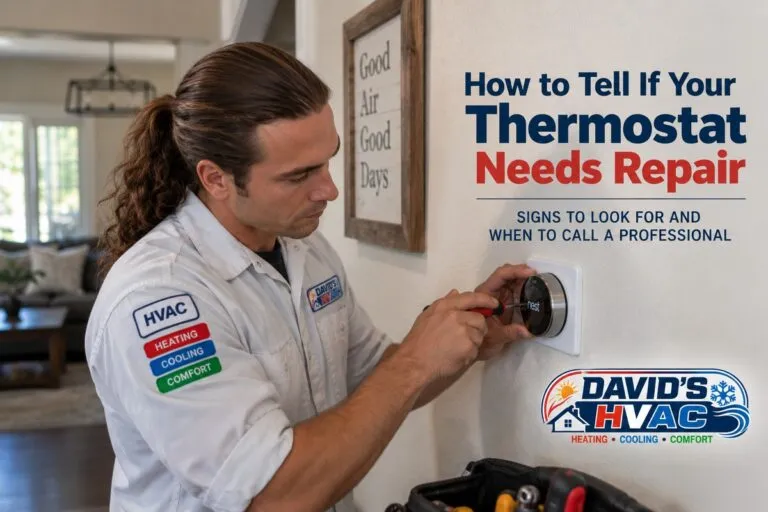
How to tell if your thermostat needs repair often comes down to noticing changes in temperature control, HVAC performance, and the way your thermostat responds to adjustments. A malfunctioning thermostat can make your home uncomfortable, cause your heating or cooling system to run longer than necessary, and sometimes make it seem like there is a larger HVAC problem.
For homeowners in Englewood, CO and throughout the Denver Metro area, thermostat problems can become especially noticeable when temperatures change quickly. Recognizing the signs of a bad thermostat can help you determine when thermostat repair or professional HVAC service may be needed.
Common Signs Your Thermostat Needs Repair
A thermostat does more than display the temperature. It tells your heating and cooling equipment when to turn on, when to shut off, and what temperature your home should maintain.
When those signals are incorrect or inconsistent, you may notice problems throughout your HVAC system.
Your HVAC System Does Not Turn On
One of the clearest signs of a thermostat problem is an HVAC system that does not respond when you change the temperature setting.
For example, lowering the thermostat several degrees below the current indoor temperature should normally cause the air conditioner to start. During heating season, raising the setting should eventually trigger the furnace or heating system.
If nothing happens, possible thermostat-related causes include:
- Loose or damaged thermostat wiring
- Failed internal components
- Incorrect thermostat settings
- A thermostat that has lost power
- Weak or dead batteries on applicable models
- Communication problems between the thermostat and HVAC equipment
However, an HVAC system that will not start does not automatically mean the thermostat is responsible. Electrical problems, equipment failures, safety switches, and other HVAC issues can produce similar symptoms.
Professional HVAC troubleshooting can help identify the actual source of the problem before parts are replaced unnecessarily.
The Thermostat Does Not Match the Room Temperature
A noticeable difference between the thermostat reading and the actual room temperature can indicate a thermostat problem.
Small temperature differences can occur naturally throughout a house. A thermostat installed in a hallway may not read exactly the same temperature as a bedroom, basement, or sunny living room.
A larger or persistent discrepancy deserves attention.
Check the Thermostat’s Location
Sometimes the thermostat itself is working, but its location prevents it from getting an accurate reading.
Temperature readings may be affected when a thermostat is located:
- In direct sunlight
- Near an exterior door
- Close to a supply vent
- Near a fireplace or other heat source
- On an exterior wall
- In an unusually warm or cold area of the home
If the thermostat has worked correctly in the same location for years and suddenly begins displaying inaccurate temperatures, the issue may be related to the thermostat sensor or another component.
Your Heating or Cooling Runs Constantly
An HVAC system that seems to run continuously can sometimes be traced back to the thermostat.
Once the desired indoor temperature is reached, the thermostat should signal the heating or cooling equipment appropriately. If that communication is not happening correctly, the system may continue operating longer than expected.
Before assuming you need thermostat repair, check that the thermostat is set correctly. Make sure the system is in the appropriate heating or cooling mode and verify the fan setting.
A fan set to “ON,” for example, can run continuously even when the furnace or air conditioner is not actively heating or cooling. Changing the fan setting to “AUTO” allows the blower to cycle with the system.
If the equipment itself continues heating or cooling after reaching the selected temperature, professional diagnosis may be appropriate.
Your HVAC System Short Cycles
Short cycling occurs when heating or cooling equipment turns on and off frequently instead of completing normal operating cycles.
A faulty thermostat can contribute to this problem if it sends inconsistent signals to the HVAC system.
Other Problems Can Cause Short Cycling
Thermostat failure is only one possible explanation. Depending on the type of HVAC equipment, frequent cycling may also be associated with airflow restrictions, equipment sizing, overheating, electrical issues, dirty components, or other mechanical problems.
That is why replacing a thermostat based on short cycling alone is not always the best approach.
An HVAC technician can inspect the thermostat along with the heating and cooling equipment to determine what is causing the repeated cycling.
The Thermostat Screen Is Blank or Unresponsive
A blank thermostat screen can be an obvious sign that something is wrong, but the cause may be simple.
For battery-powered thermostats, checking or replacing the batteries is a reasonable first step. Some thermostats receive power directly from the HVAC system, which means a blank screen could indicate a power or wiring issue elsewhere.
Possible causes of a blank or unresponsive thermostat include:
- Dead thermostat batteries
- Tripped circuit breakers
- Loose wiring
- Loss of HVAC system power
- A blown low-voltage fuse
- Internal thermostat failure
If replacing the batteries or checking basic settings does not solve the problem, avoid repeatedly resetting breakers or opening HVAC electrical components unless you are qualified to work with them.
The Thermostat Does Not Respond to Temperature Changes
Changing the thermostat setting should produce a predictable response from your HVAC system.
There may be a brief delay before the system starts, particularly with equipment that uses built-in protection delays. But if you repeatedly change the temperature and receive no response, there may be a communication problem between the thermostat and HVAC equipment.
Look for Delayed or Inconsistent Responses
Thermostat problems are not always complete failures. A thermostat may work intermittently.
You might notice that:
- The system responds to some temperature changes but not others
- The thermostat buttons or touchscreen occasionally stop responding
- Heating or cooling starts much later than expected
- The thermostat randomly resets
- Settings change or disappear unexpectedly
- The system works after restarting the thermostat but soon develops the same problem
Intermittent thermostat problems can be frustrating because the HVAC system may appear normal by the time a technician arrives. Keeping track of when the problem occurs can make troubleshooting easier.
Your Home Has Unexpected Temperature Swings
Indoor temperatures naturally vary somewhat, especially in multi-story homes. Significant temperature swings around the thermostat’s set point, however, may indicate a control problem.
Suppose you set your thermostat to 70 degrees during the heating season. If the furnace consistently allows the house to become noticeably colder before starting, then overheats the space before shutting down, the thermostat may not be controlling the system properly.
Temperature swings can also result from other HVAC problems, so accurate diagnosis is important.
The Thermostat Keeps Losing Its Settings
Programmable and smart thermostats are designed to retain schedules and temperature settings. Repeatedly losing those settings can indicate a problem with the thermostat, its power source, or its configuration.
Pay attention if your thermostat frequently:
- Returns to default settings
- Loses programmed schedules
- Changes temperatures unexpectedly
- Restarts without being touched
- Displays incorrect time or date information
- Disconnects repeatedly from connected features
Before scheduling thermostat repair, check whether programmed schedules or energy-saving settings are intentionally changing the temperature. Smart thermostats can make automatic adjustments depending on their configuration.
If unexplained resets continue, the thermostat or its power supply may need professional attention.
Your Energy Bills Increase Along With Thermostat Problems
An unexplained increase in heating or cooling costs can sometimes accompany a malfunctioning thermostat.
If a thermostat causes an HVAC system to run longer, cycle unnecessarily, or maintain a different temperature than intended, energy consumption may increase.
However, higher utility bills alone are not enough to diagnose a faulty thermostat. Denver-area weather conditions, HVAC maintenance issues, insulation, air leaks, dirty filters, aging equipment, and changes in household usage can all affect energy consumption.
Thermostat trouble becomes a stronger possibility when increased energy use occurs alongside symptoms such as inaccurate temperature readings, excessive HVAC runtime, or irregular cycling.
Check These Simple Issues Before Scheduling Thermostat Repair
Some apparent thermostat problems can be corrected without a repair.
Before calling for HVAC service, you can perform a few basic checks that do not require opening electrical equipment.
Verify the Thermostat Settings
Confirm that the thermostat is set to the correct operating mode.
During summer, select “COOL.” During colder weather, select “HEAT.” Then adjust the target temperature enough to create a clear demand for heating or cooling.
Also check whether the fan is set to “AUTO” rather than “ON” if you do not want the blower running continuously.
Check the Batteries
If your thermostat uses replaceable batteries, weak batteries can cause display or operating problems.
Install fresh batteries according to the thermostat manufacturer’s instructions and see whether normal operation returns.
Check the Circuit Breaker
A tripped breaker may prevent HVAC equipment from operating and, on some systems, can affect thermostat power.
If a breaker has tripped, follow appropriate electrical safety practices. A breaker that trips repeatedly can indicate an electrical or equipment problem that should be inspected rather than continually reset.
Inspect the Thermostat From the Outside
Look for obvious signs of physical damage, a loose thermostat body, or an unresponsive display.
Avoid removing wires or attempting electrical repairs if you are unfamiliar with low-voltage HVAC controls. Incorrect thermostat wiring can prevent equipment from operating and potentially damage system components.
When a Thermostat Problem May Actually Be an HVAC Problem
Many thermostat symptoms overlap with furnace and air conditioning problems.
A thermostat that appears to be malfunctioning may actually be responding correctly to an HVAC system that cannot complete the command it receives.
For example, an air conditioner that will not start could have a thermostat issue, but it could also have an electrical, control, or equipment problem. Similarly, a furnace that cycles frequently may have an airflow or overheating issue rather than a defective thermostat.
Professional Diagnosis Can Prevent Unnecessary Replacement
A proper thermostat diagnosis may involve checking:
- Thermostat settings and calibration
- Low-voltage wiring
- Electrical connections
- Thermostat power
- Communication with the HVAC equipment
- Heating and cooling system operation
- Relevant HVAC controls and safety devices
Testing the complete system helps determine whether thermostat repair, thermostat replacement, or a different HVAC repair is actually necessary.
Should You Repair or Replace a Faulty Thermostat?
Whether thermostat repair or replacement makes more sense depends on the problem and the type of thermostat installed.
A wiring or connection issue may be repairable without replacing the thermostat itself. If the thermostat has an internal component failure, replacement may be the more practical solution.
Older thermostats may also be worth replacing when repairs are no longer cost-effective or when compatibility with newer HVAC equipment becomes an issue.
Thermostat Compatibility Matters
Not every thermostat works with every heating and cooling system.
Compatibility can depend on the HVAC equipment, wiring configuration, number of heating or cooling stages, heat pump controls, and power requirements.
Smart thermostat installation can involve additional considerations as well. Some models require a common wire, often called a C-wire, or another approved method of providing continuous power.
Choosing a thermostat based only on appearance or features can lead to installation and performance problems if it is not compatible with the HVAC system.
When to Call for Thermostat Repair in Englewood, CO
If basic troubleshooting does not solve the problem, scheduling HVAC service can help determine whether the thermostat is actually failing.
Consider professional thermostat repair or HVAC diagnosis if:
- Your thermostat does not activate the heating or cooling system
- The displayed temperature appears consistently inaccurate
- Your HVAC equipment cycles on and off unusually often
- Heating or cooling continues after reaching the set temperature
- The thermostat repeatedly loses settings or restarts
- The display remains blank after basic checks
- The system responds inconsistently to thermostat adjustments
- You suspect damaged or loose thermostat wiring
Colorado’s changing temperatures place significant demands on both heating and cooling systems throughout the year. Reliable thermostat operation helps your HVAC equipment respond correctly when indoor temperatures need adjustment.
If you are experiencing signs that your thermostat needs repair in Englewood, CO or the Denver Metro area, David’s HVAC can inspect the thermostat and HVAC system to identify the source of the problem. Professional troubleshooting can determine whether you need thermostat repair, thermostat replacement, or service elsewhere in your heating and cooling system so you can restore dependable temperature control in your home.
Content reviewed and published according to the David's HVAC Editorial Team.