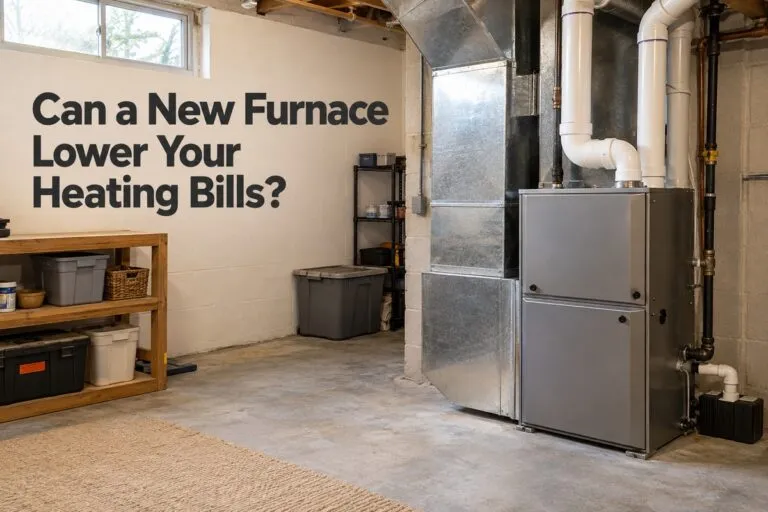
Can a new furnace lower your heating bills? In most cases, yes. A new, high-efficiency furnace uses less gas to make the same amount of heat. That means a smaller bill each month, especially during a cold Colorado winter.
If your furnace is old, loud, or always running, you may be paying more than you need to. Let’s look at how much a new furnace can save and what you can do to get the most from it.
How a New Furnace Can Lower Your Heating Bills
A furnace turns fuel into heat. Older furnaces waste a lot of that fuel. The heat goes up the flue instead of into your home.
A new furnace wastes much less. You pay for gas, and more of it actually warms your rooms.
Here is what helps you save:
- Less wasted fuel
- Smarter blowers that use less electricity
- Even heat, so the furnace doesn’t run nonstop
- Better parts that work as a team
What Does AFUE Mean?
AFUE stands for Annual Fuel Utilization Efficiency. It is a percentage. It tells you how much of your fuel becomes heat for your home.
For example, a furnace with an AFUE of 80% turns 80 cents of every dollar into heat. The other 20 cents is lost.
According to the U.S. Department of Energy, older furnaces can have an AFUE as low as 56% to 70%. New gas furnaces start at 80%. High-efficiency models reach 90% to 98.5%.
AFUE Ratings at a Glance
- Old furnace (15 to 25 years): about 56% to 70%
- Standard new furnace: about 80%
- High-efficiency new furnace: about 90% to 98%
How Much Can You Save With a New Furnace?
Let’s do the math. Say you have an older furnace with a 65% AFUE. You replace it with a 95% AFUE furnace.
That is about a 30% drop in the gas you need to make the same heat. If your yearly heating bill is $1,000, you could save around $300 a year.
Your results will be different if your home is bigger, older, or leaks more air. But the numbers show why a furnace upgrade can pay off.
Savings Examples Based on a 65% AFUE Furnace
- Replace with an 80% furnace: about 19% less gas
- Replace with a 90% furnace: about 28% less gas
- Replace with a 96% furnace: about 32% less gas
These are estimates. Your actual savings depend on your home, your gas rates, and how you use your heat.
Signs Your Old Furnace Is Costing You Money
Your furnace may tell you it is time for a change. Watch for these signs:
- Your gas bill keeps going up, but your habits haven’t changed
- Your furnace is more than 15 years old
- Some rooms stay cold while others are hot
- You hear banging, rattling, or squealing
- The furnace turns on and off a lot
- You need repairs more and more often
- There is extra dust in the air
The Department of Energy says most furnaces last about 15 to 20 years. If yours is near that age, a new one may save money fast.
Repairs vs. Replacement: What Costs Less?
A repair can seem cheaper in the moment. But an old furnace keeps wasting fuel, even after it’s fixed.
Think about replacement if:
- The repair costs a lot compared to a new system
- You have paid for repairs more than once in the last two years
- The furnace is 15 years old or older
- Your bills keep rising
A new furnace can cut your bills and your repair costs at the same time. That is a double win for your wallet.
Single-Stage, Two-Stage, and Variable-Speed Furnaces
The type of furnace you pick can change how much you save.
Single-Stage Furnaces
These run at full power every time. They are simple and cost less up front. But they turn on and off a lot, which can waste energy.
Two-Stage Furnaces
These have a low setting and a high setting. On most days, they run on low. That uses less gas and keeps the temperature steadier.
Variable-Speed Furnaces
These adjust their heat and airflow in small steps. They run longer at lower power. This gives you even heat, quiet comfort, and strong savings. Their blowers also use less electricity.
Why Denver Metro Homes Can Benefit From a New Furnace
Colorado winters are cold, and our furnaces work hard. Homes in Englewood, Denver, Littleton, Centennial, and nearby areas often run their heat from October through April.
The more your furnace runs, the more an efficient model can save you. A furnace that wastes 30% of your fuel costs more every single cold month.
Altitude also matters. Denver sits about 5,280 feet above sea level. Gas furnaces need to be set up correctly for high elevation. A pro who knows our area will make sure your furnace burns gas the right way and runs safely.
Other Things That Help You Save More
A new furnace is a big step. A few other things can help you save even more.
Seal and Fix Your Ducts
Leaky ducts let heated air escape into the attic or crawl space. ENERGY STAR says sealing and insulating ducts can improve your heating and cooling efficiency by up to 20%.
Use a Smart or Programmable Thermostat
Turning your thermostat down when you are asleep or away saves fuel. The Department of Energy says you can save about 10% a year by turning your thermostat back 7 to 10 degrees for 8 hours a day.
Add Insulation and Seal Air Leaks
If warm air leaks out, your furnace has to work harder. Sealing gaps around doors, windows, and the attic helps your home hold heat.
Change Your Filter
A dirty filter blocks airflow. Your furnace must work harder and use more energy. Check your filter every month or two during winter.
Get the Right Size Furnace
Bigger is not always better. A furnace that is too big turns on and off too often. This wastes energy and wears out the parts faster.
A furnace that is too small can’t keep your home warm on the coldest days.
A good HVAC company will do a load calculation. This looks at your home’s size, insulation, windows, and layout. It makes sure you get a furnace that fits your home just right.
Questions to Ask Before You Buy a New Furnace
Before you decide, ask your HVAC company:
- What AFUE rating do you recommend for my home?
- How much could I save each year?
- Does my ductwork need repairs or sealing?
- What type of furnace is best for Denver winters?
- What warranty comes with the furnace and the installation?
- Are there utility rebates or incentives right now?
Rebates change from time to time. Check with your utility provider and ask your HVAC pro what is available today.
Does a New Furnace Make Your Home More Comfortable?
Yes, and that is a nice bonus. A new furnace can give you:
- Even heat from room to room
- Quieter operation
- Cleaner air with better filtering
- Safer performance, since older furnaces can develop cracks and leaks over time
Lower bills are great. A warm, steady home is even better.
A new furnace can lower your heating bills, and for many Colorado homes the savings add up fast. If your furnace is old, noisy, or costing you more each winter, an upgrade can put money back in your pocket while keeping your family warm.
The team at David’s HVAC helps homeowners in Englewood and across the Denver Metro area pick the right furnace, install it the right way, and start saving. Call us today to schedule a furnace evaluation and find out how much a new furnace could save you.
Content reviewed and published according to the David's HVAC Editorial Team.